
Leading Glue Production Line Equipments Manufacturer.
Tel: +86 181 3837 3963 | jctben@mixmachinery.com
Tel: +86 181 3837 3963 | jctben@mixmachinery.com

Pure polyurethane itself is a poor conductor of heat, but by filling a high proportion of thermally conductive powders (such as Al₂O₃, Al(OH)₃, AlN, etc.) into the polyurethane matrix, it can be modified into thermally conductive polyurethane adhesive. In power batteries, it is commonly referred to as TIM (thermal interface material) or thermally conductive structural adhesive.
In new energy vehicle battery packs, it has three main key application scenarios:
Leveraging its extensive experience in industrial high-viscosity mixing, JCT has launched a new generation of fully automated PU glue production line for thermal conductivity of power battery.
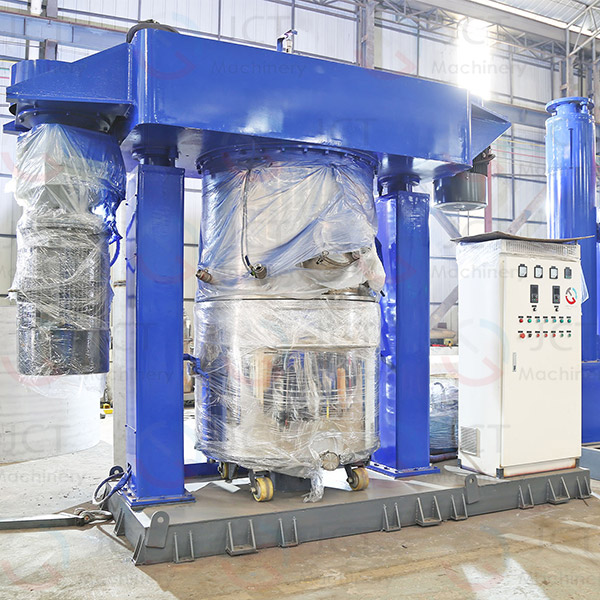
1. Double planetary high-intensity mixing system | Conquering "toothpaste-like" non-bull fluids
Pain point: When the powder filling rate exceeds 70%, the material viscosity surges to hundreds of thousands of mPa·s. Ordinary frame mixers cannot achieve uniform mixing, easily leading to localized overheating and carbonization.
Solution: The core mixer employs a dual planetary high-intensity mixing structure. The mixing paddles revolve around the vessel's axis while simultaneously rotating at high speed, combined with low-speed bottom and wall scrapers, subjecting the material to intense multi-dimensional shearing, kneading, and rubbing within the vessel. This ensures perfect compounding of a high proportion of powder and polyurethane base material within one hour.
2. Deep high degassing technology | Ensuring >15 insulation and high withstand voltage
Pain point: The thermally conductive adhesive for power batteries absolutely cannot contain even a trace of air bubbles; otherwise, after curing, these air pores will form a thermal resistance barrier, potentially leading to high-voltage breakdown.
Solution: The reaction system is equipped with a high-displacement Roots-rotary vane vacuum pump set, maintaining a stable dynamic vacuum level inside the cylinder above -0.098MPa. Combined with the unique tumbling convection design of the stirring paddle, tiny air bubbles hidden inside the high-viscosity adhesive are completely removed.
3. Deep powder vacuum dehydration process | Eliminating safety hazards
Pain point: Isocyanate (component B) in PU adhesive solidifies upon contact with water. The surface of thermally conductive powder readily absorbs trace amounts of moisture; if not completely removed, this can easily lead to explosive agglomeration and "catastrophic failure" on the production line.
Solution: Install an independent vacuum drying and preheating system for the powder at the front end of the production line, or perform ultra-high temperature vacuum dehydration during the kneading stage of component A (moisture content controlled below 0.05%) to ensure the chemical reaction is under absolutely safe and controllable conditions.
Our PU glue production line for thermal conductivity of power battery completely solves the problems of dead reactors, short equipment lifespan, and insulation breakdown, helping you easily enter the supply chain of new energy vehicle manufacturers: +86-181 3837 3963 (Whatsapp, Wechat), jctben@mixmachinery.com.
Technical Support: Magic Lamp - Website


 Home
Home


 +86 18138373963
 jctben@mixmachinery.com


