


 Home
 JCT
 Nov 18,2026

How to Set Up a Tire Repair Sealant Manufacturing Plant?
Setting up a tire repair sealant plant is less about buying one machine and more about integrating a complete process — raw material handling, heated mixing in a reactor, filtration, deaeration, filling and sealing — into one line that runs consistently. JCT Machinery builds that line as a turnkey project: equipment manufacturing, chemical formulation and plant planning from a single source, with 3D process design before a single part is cut.
Why "buying machines" is the wrong way to start
Tire repair sealant and tire repair fluid are viscous, temperature-sensitive preparations. They must be heated and mixed to a uniform state, filtered, freed of entrained air, then metered accurately into bottles or cans that are capped and sealed. Buy the reactor first and you will quickly discover the gaps: no matching filter, a filling machine that cannot handle the viscosity, a heating method that suits a different utility supply, or a formula nobody has validated on that equipment.
A plant is a chain. Its output is limited by its weakest link, and the links must be specified against the same material and the same target output. That is why the first decision is not a model number — it is a process layout.
What a tire repair sealant line actually contains
Two real JCT configurations show how the scope changes with the product form.
A 3000L tire repair glue production line was built around a 3000L vessel with a DN400 quick-open manhole, Φ1500 × 1500 × δ8 SS304 chamber, 0–85 rpm agitation and 72 kW electric heating (6 kW × 12), plus a QBY-50 pneumatic diaphragm pump (Q = 0–12 m³/h) and a 25 m² SS304 heat exchanger. Critically, the supply scope also included the technical formula, raw material list, material suppliers, the specific production process, and technical advice when problems are encountered — the non-equipment items that determine whether a new plant actually starts.
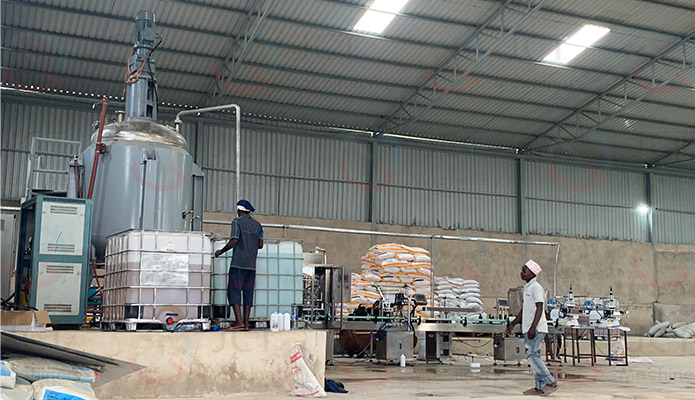
A 3000L tire repair fluid filling line took a different route: a 3000L reactor (15 kW, Φ1500 × 1500 × δ8 SS304, 0–85 rpm, 72 kW heating) feeding a feed pump, filter, frequency converter, water tower and 5.5 kW water pump, then a four-head filling machine, cap-and-lock machine and aluminum foil sealing machine. Here the value sits in accurate metering and packaging, not only in mixing.
For larger batches, a 6000L tire repair glue reactor uses an external half-pipe heating zone plus a 120 kW steam-electric generating unit (165 kg/h steam, 0.7 MPa, max 160°C) instead of an external boiler — a practical answer for sites without a steam supply. Its SS304 inner cylinder is Φ1800 × H2200 × δ8 with a φ90 shaft at 0–80 rpm and three-blade agitation, served by a 12 m² vertical condenser, ZCQ magnetic drive feed pump and KCB gear discharge pump (both 12 m³/h, 5.5 kW explosion-proof motors), a 40 t/h cooling tower and a floor-standing control cabinet with temperature display and control.
None of these are catalogue machines sold off a shelf. Each was configured around a specific product and site.
What turnkey really covers
JCT's turnkey scope runs from feeding and reaction through dispersion, deaeration, discharge and packaging — full-process design and equipment integration. The model combines equipment manufacturing, chemical formulation and plant planning in one package, and the company has delivered more than ten automated production lines, including lines at 30–50 tons per day (a specific project's capacity, not a general factory rating).
For a new plant investor, that means:
- Process design first. Every project starts from a 3D process demonstration; blade profile, torque, vacuum and temperature control are designed around the actual material, with drawings delivered within three days.
- Equipment built in-house. The source factory in Foshan handles design, machining, welding, assembly and trial running, and customers can test with their own material on site.
- Formula and raw materials included. The referenced production lines list technical formula, raw material sourcing and the specific production process as part of supply — not as an afterthought.
- Installation, testing and training. These are part of the delivery scope, backed by three years of after-service support.
Why a source factory matters for a new plant
JCT Machinery was established in 2006 and has around 20 years of experience in high-viscosity mixing and reaction equipment. The company holds 17 utility-model patents and 2 software copyrights, with ISO 9001 and ISO 14001 certification and CE marking. It has served more than 3,000 customers, from single-machine buyers to turnkey plant investors, and exported to North America, Europe, Africa, Southeast Asia, the Middle East, the CIS and South America. Around 95% of orders involve customized production lines.
One relevant proof point: a tire repair fluid production line was delivered to a customer in Tanzania and commissioned locally. It is a small but meaningful marker — the product category is being built in emerging markets, not only discussed in catalogues.
How to plan the budget without guessing
A line's cost depends on vessel volume, contact material, heating method, automation level and how much of the packaging train is included. A reactor-only scope and a full filling line are not comparable quotations. When you request a proposal, specify:
- product type and target batch volume;
- viscosity and whether the formula needs heating or cooling;
- required output per shift;
- packaging format (bottle, can, cartridge) and filling accuracy;
- available utilities — steam, electricity, cooling water;
- whether formula and raw material sourcing are needed.
Ask each supplier to state what is excluded as clearly as what is included. Utility connections, water treatment, site work, spare parts and freight are the usual post-contract additions. No responsible manufacturer will quote a plant from a one-line enquiry, and you should be cautious of one that does.
Start with the process, not the price list
If you are planning a tire repair sealant or tire repair fluid plant, the fastest route to a reliable answer is to send your product type, target output and packaging format. JCT will return a process layout and a configured line — built around your material, not a generic catalogue.
JCT Machinery — source factory and turnkey partner for high-viscosity mixing and production lines. We don't just sell machines — we make your production line run.
 What equipment is needed for pillow hot melt glue production line?
 +86 18138373963
 jctben@mixmachinery.com


