



 Home
 JCT
 Nov 25,2026

PVA Glue Production Line Turnkey Project: From Emulsion Reactor to Filling
PVA glue is often treated as one of the easier adhesives to make: a water-based dispersion, a reactor, a filling line. In practice, the difficulty sits between those steps. Emulsion consistency depends on how heating, agitation and reaction time are controlled; a batch that is slightly off-spec cannot be corrected later by filtration or filling. Then there is the hand-off problem — a reactor that finishes on schedule but feeds a cooling or filling station that cannot keep pace turns a good reaction into a bottleneck. For a producer commissioning a PVA glue production line, the real question is not which machine to buy but who is accountable for the interfaces between them. A turnkey PVA glue plant answers that by engineering reaction, cooling, transfer and filling as one controlled sequence.
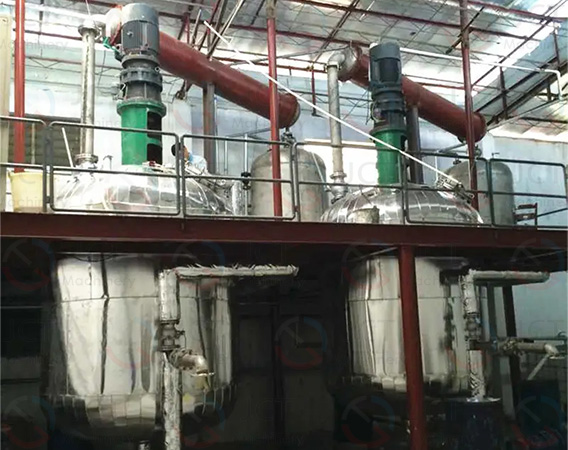
What buyers of water-based adhesive lines actually ask for
In international trade, "PVA glue" usually refers to the water-based white glue family — white latex / PVAc emulsion — used in woodworking, paper converting, packaging and general bonding. Buyers in this segment are not only comparing viscosity or solid content; they ask about consistency from batch to batch, about how the line behaves when the formulation changes, and about whether the supplier understands plant utilities rather than just selling vessels. In PVA adhesive manufacturing, two constraints come up repeatedly. First, utilities differ by site: steam, cooling water, chilled oil and available voltage are never identical, so heating and agitation must be specified against the real plant, not a catalogue default. Second, hygiene and changeover matter in multi-grade production — the line must be cleanable between runs without turning cleaning into a full shutdown. A line designed around those questions from the start avoids expensive modification after installation.
One partner from equipment to repeatable output
JCT is a source factory for high-viscosity mixing and reaction equipment, and a turnkey line integrator — we don't just sell machines, we make your production line run. For a water-based adhesive line, that means three layers of delivery.
Equipment. Reactors and dispersing equipment configured to the process, with agitator, heating and sealing chosen for the formulation rather than pulled from a standard list.
Line. Feeding, reaction, dispersion, cooling, de-airing, discharge and packaging integrated and commissioned as one system — the scope a turnkey PVA glue plant is judged on.
Repeatable capability. PLC control with recipe management and protected programmes, so a grade that runs correctly on Monday runs the same way next month, and can be reproduced when the line is scaled.
Because 95% of our orders are custom lines rather than standard machines, every customized adhesive line we deliver is engineered around the process — this integration is our normal work, not an exception. As a source factory for adhesive lines rather than a trading company, we carry responsibility for the interfaces between machines.
Evidence behind the claim
Several facts make that position concrete. We have been building mixing and reaction equipment since 2006, from a 5,000 m² plant with a team of around 50. Our engineers have delivered more than 10 automated production lines, and we hold 17 utility model patents plus 2 software copyrights. Equipment spans 5-litre laboratory units to industrial machines above 10,000 litres, so a pilot grade can be developed and then scaled without changing supplier. Our quality and environmental management systems are certified to ISO 9001 and ISO 14001, and our equipment carries CE marking. We have served more than 3,000 customers, with exports to North America, Europe, Africa, Southeast Asia, the Middle East, the CIS and South America. For a buyer evaluating PVA glue production line manufacturers, this record matters less as a badge than as evidence that the hand-offs between machines have been solved many times before.
What the line actually contains
The reactor is the core
White latex and PVAc emulsions are produced by reaction and dispersion in a liquid phase, so the reactor sets the pace. Our PVA glue reactor is a complete reaction vessel, with body, transmission, agitation, sealing, heating and cooling arranged around the process. Standard configurations cover 50 L to 30,000 L and, in the extended range, 20 L to 80,000 L; working volume is about 80–90%, operating temperature runs from normal temperature to 300 °C, and pressure from vacuum (-0.1 MPa) to 0.6 MPa. Agitators are selected from paddle, anchor, frame, ribbon, turbine, dispersing disc and combined types; materials include SUS304, SUS321, SUS316L stainless steel and Q235-B carbon steel. Heating can be electric, steam or water bath, with heat transfer oil, steam, hot water or electric as the medium, arranged through a jacket, external half-pipe or internal coil. For discrete dispersion tasks, a high-speed disperser with low-speed stirring is available in the same line.
Supporting equipment and systems
A reactor alone does not make a white latex production line. The line is completed with metering tanks, fractionating columns, condensers, water separators, collecting tanks and filters, together with heating, cooling, vacuum, nitrogen generation, feeding, discharge and packaging systems. Heat transfer oil circulation, jacket electric heating, steam heating and cold oil or cold water cooling can be matched to the utilities available on site. These are the components that turn a vessel into a working PVA glue production line.
Automatic control and safe operation
The process runs under PLC control: raw materials are metered, batched and conveyed automatically; reaction steps are set in advance, with temperature, pressure, reaction time and agitation speed controlled automatically; and the finished product is transferred to storage for automatic filling or packaging. The reactor itself is built for controlled heating, reaction, cooling and mixing — heating speed is kept moderate to avoid sudden temperature rise, temperature, pressure and stirring speed are monitored in real time, and the vessel is protected by safety accessories such as safety valves and overpressure protection devices. Operation follows a defined sequence: prepare and clean the vessel, charge liquids and gas as required, react under monitoring, release pressure, cool, and discharge. This is what makes a custom PVA glue production line repeatable rather than dependent on one operator.
Capability and compliance
We do not claim a delivered PVA glue reference where we do not have one. Our resin and adhesive lines are built on the same reactor-based synthesis and downstream handling logic used across water-based adhesive production, and it is that transferable part — reactor engineering, dispersion, batch control and line integration — that we bring to a new project. On the compliance side, our management systems are certified to ISO 9001 and ISO 14001, and the reactor and sigma mixer series carry CE marking. As a white latex equipment supplier, we invite customers to the Foshan plant — with 3–5 days' notice so a trial run can be prepared.
Delivery and after-service support
Every project starts with a 3D process demonstration, and drawings are issued within three days of process confirmation. Standard machines ship in about 30 days; a custom water-based adhesive line takes 30–60 days, with 7–15 extra days reserved for export packing and documentation. Each delivery includes installation, commissioning and operator training, plus 3 years of after-service support.
Start with your formulation, not a catalogue
Tell us the glue type, batch size, target output and how many grades you plan to run, and we will come back with a configuration and a 3D process layout — not a generic brochure. If you are comparing PVA glue production line manufacturers, the useful question is how each one handles the interfaces between reaction, cooling, filtration and filling.
Ready to scope your PVA glue line? Send your formulation and target output to jctben@mixmachinery.com or visit gdgluemixer.com.
 How to Set Up a Tire Repair Sealant Manufacturing Plant?
 +86 18138373963
 jctben@mixmachinery.com


